Sociability • Communication
When People Start To Get Interesting…
We may spend a considerable portion of our lives chewing over – in the background – a highly consequential-sounding question: how might we be, or become, that most valuable of things, an interesting person? We may listen with envy at how others are described as ‘great conversationalists’ or ‘amazing company’. How did they learn how to be an interesting person? How does someone like us, an average, rather struggling soul, become ‘interesting’?
The standard answer tends to point us in two directions: towards the acquisition of knowledge and experience. The interesting person knows a lot: the circumference of Mars, when and why the canals were built, how Hindus bury their dead, the first recorded poem, the chemical composition of coal. They keep their audiences fascinated with a stream of rare and penetrating facts. Then there are experiences. The interesting person has travelled far. They spent a night at the very bottom of Patagonia. They met some associates of the Dalai Lama. They’ve just come back from Lomo. Their work might have taken them to a project for a dam in the depths of the Democratic Republic of the Congo. Interest is about stories. Interest is for people who do not stay at home.
How to Be an Interesting Person
But here comes an alternative, more modest and hopeful proposal. If we really want to be interesting, we need do nothing as strenuous as travel to another continent or read the Upanishads (again). What we need to do – above all else – is let other people into the reality of our lives.
This is not necessarily as straightforward as it sounds. Our reality is, after all, no simple or unfrightening matter. It includes such things as: the extraordinary sexual fantasies that have pursued us all week; the moments of complete despair when we thought rather seriously about ending our lives; the feelings of bitterness and anger towards so-called friends; our sporadic hatred of family members we’re meant to love; our regrets at so much that we’ve done.
The Hidden Reality of Everyone’s Inner Life
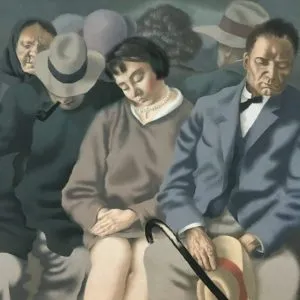
We spend a great deal of energy disowning this material out of shame and fear. No one – we believe – could possibly either be quite like we are or be sympathetic to us. No one must ever know. On a planet of eight billion people, we are among the very, very oddest ones. No one – surely – is as perverse, as lonely, as sad, as angry and as deeply silly. No one has these issues with their body, with sex, with money, with friends and with anxiety.
Except, of course, they do – very much so. And yet we have collectively, through a mixture of accident and embarrassment, walled ourselves off from the authentic hearts of others by constructing an image of normality that has nothing to do with what is actually normal.
We become properly interesting when we can dare to believe that the façade we are being shown by others is just that – and that everyone is secretly pining to say what no one says.
We become interesting when we can hint to our friends and companions, in ways that are ideally somewhat light-hearted and without immediate demands, what it is actually like to be alive within ourselves; when we stop the subterfuge and the dressing up and, exhausted by the pressure of having to perform the role of an adequate human, surrender to what is actually going on inside us. We become properly fascinating, even if we’ve never been to Khartoum and don’t know anything about the paintings of Seurat or the poetry of Louis MacNeice, when we’re able to recount – without too much artifice – what we fantasised about last night, or despaired over this morning, why we hate ourselves so much and who we wish we could get in contact with, if only we weren’t so cowardly.
We become both fascinating and a source of immense relief when we can tell others, in essence: I am an absurd, comedic, beautiful, idiotic, crazy, mad person, as you are, as we all are, and would gain such solace from knowing it, if only we didn’t pretend so much all the time.
The interesting person is the one who saves us from our solitary false dignity and lets us admit, with laughter, to our folly. They release our prison gates. They let us know, by example, that most of what we are has an echo in someone else.
We are all delightful, crazy and intensely interesting when we can allow the grandstanding to fall away. We are just waiting to hold out a hand to our similarly tormented, similarly odd and similarly lovely fellow human. In the end, how to be an interesting person may simply mean learning to speak honestly about what it is like to be us. These are life’s properly interesting moments.