Self-Knowledge • Perfectionism, Expectations & Messing up
Happiness Is Not a Still Image
It’s a curious feature of the way we imagine the future, especially its happy varieties, that we typically base our impressions on just one or two still images – as if happiness is not a destination we travel through in time, but a single frozen scene we might one day inhabit. Enormous plans that determine the shape of major chapters of our lives (and that might involve lengthy educational commitments, legal obligations, years of sacrifice and so on) may be set in motion with, and be guided by, nothing more searching or detailed than a handful of internal postcards.
For example, when we think of the word ‘retirement’, we might picture a cottage, a view onto the sea, a clear sky and a path down to some cedar trees. ‘Marriage’ might bring to mind simply a kitchen, a kindly figure by the stove and a softly lit dining table. ‘Children’ might prompt a picture of a playground and a smiling small person on a swing. ‘Success’ might summon up the lobby of a black lacquer-panelled hotel decorated in a faintly East Asian style.
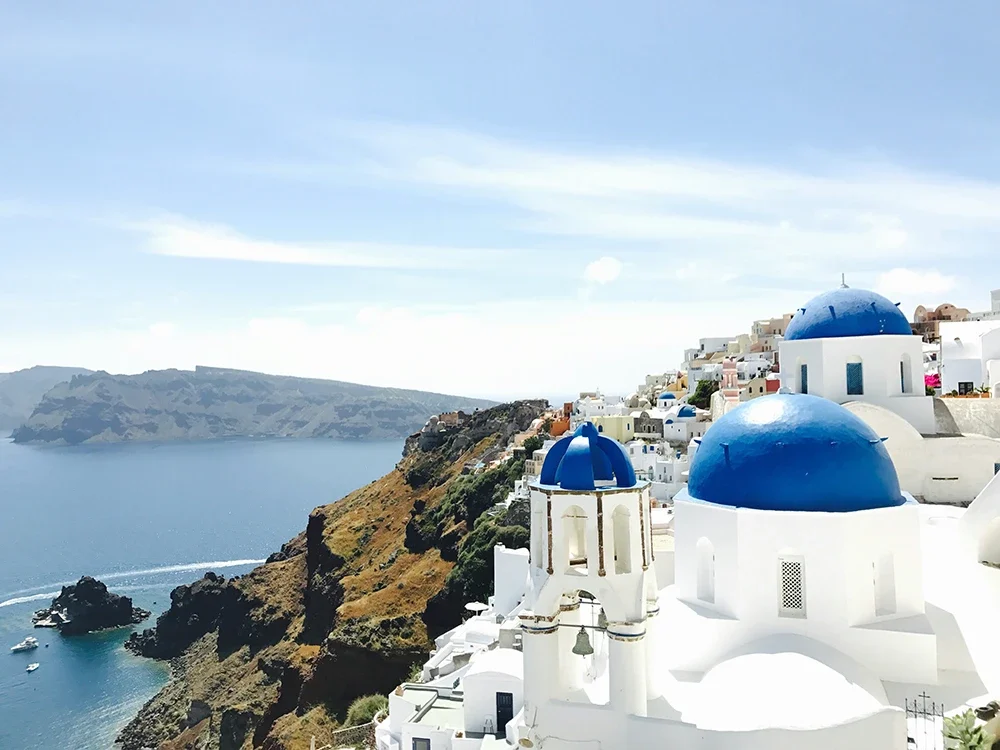
Our proclivity to picture our goals in terms of still images is especially apparent when it comes to travel. We might formulate a wish to go to ‘Greece’ (a journey involving an enormous outlay and complex logistics) and see just a whitewashed village, some blue fishing boats in the harbour and a windmill on a hillside. ‘Switzerland’ might be folded into a chalet in the snow; ‘Vietnam’ might disappear into a section of the beach at Hoi An at dusk.
When Reality Refuses to Stay Still
But as we are made aware whenever we actually activate our plans, reality has a peculiar habit of revealing itself to be far more dense and multiple than our projections envisage. We may fantasise in terms of still images without any sound; but we have to live in real time in an entirely unedited (and uneditable) roll of moving film, which has not only a soundtrack (indeed ten soundtracks), but also a direct feed from our bodies – our stomachs, our limbs, our backs – as well as a restless jumbled stream of subtitles that look simultaneously backwards and forwards, that ask no end of strange questions, that wonder why we exist, that compare our condition with those of friends and rivals, and that ceaselessly wish we could be elsewhere and might have done something else with someone else in another place.
If we were to go to Greece, we’d quickly find that the postcard that had inspired our trip was part of a far more panoramic and demanding work that also comprised a long unair-conditioned wait at the airport, a giant advertisement for ouzo by a baggage carousel, a cramped yellow taxi down to Piraeus, a set of mournful reflections about our family while waiting in line for water, a traffic jam in a suburb full of smashed warehouses inhabited by gangs of stray cats, a panic about an email to a colleague at a traffic light, another wait by a putrid-smelling jetty, a stomach ache in a cramped toilet on the ferry to Samos, pulses of nostalgia for our old job in a bakery by a snorkel shop, insomnia by a bank of air conditioners – and so on and so forth.
The Turbulence of Love
The lesson is as humbling when it comes to love. In our single state, we dream of ‘having a partner’ and latch on to nothing more than an out-of-focus image of a smiling elegant face on our sofa. And then, after interminable rounds of dating, we might finally begin a story with William or Samantha, Petra or Luis, and recognise that our feelings for them might contain, in five minutes, more variety than we had imagined could fill a conjugal lifetime. We like them a lot, then we doubt them, then we wonder if they are mocking us, then we remember our ex with fondness, next comes a sexual fantasy, followed quickly by a burst of disgust, then a longing to marry them, then a desire to run away, then a wish to embrace them and never let them go. And this might still only have covered the period from 7.08 to 7.10 a.m.
The multiplicity is exhausting and untenable. To escape it, we pretend, to ourselves and the world, that we are solid propositions. We say: ‘This is my girlfriend or boyfriend.’ Or: ‘Here is my partner.’ We plan marriage. We say: ‘I love you.’ We don’t add (for now, for this instant…).
We are made largely of water, and our personalities are as viscous and evasive. We’re nothing but an alternating succession of moods. Keen students of the functioning of our minds know that our more fixed pronouncements can only ever be cover stories. The heart is intermittent. The married person continues to doubt. The one who rejected still somewhere adores. Declarations of love are followed, in short order, by renewed mental peregrinations. Hatred contains its opposite. We cycle through seventeen emotions before breakfast.
Happiness Is Not a Destination
We live among many solid things and long to confuse ourselves with them. But we can’t, in the end, be statues, boulders or rocks. We are flightiness, we are fog, we are fast-flowing streams and clouds. We yearn for certainty and must make our peace with doubt, flickering and static – and in doing so remember that happiness is not a destination, but something shifting and momentary that we pass through, lose, regain and reinterpret as we move.